Opinion
The Fall of Mekelle Is Not the End of Ethiopia's War
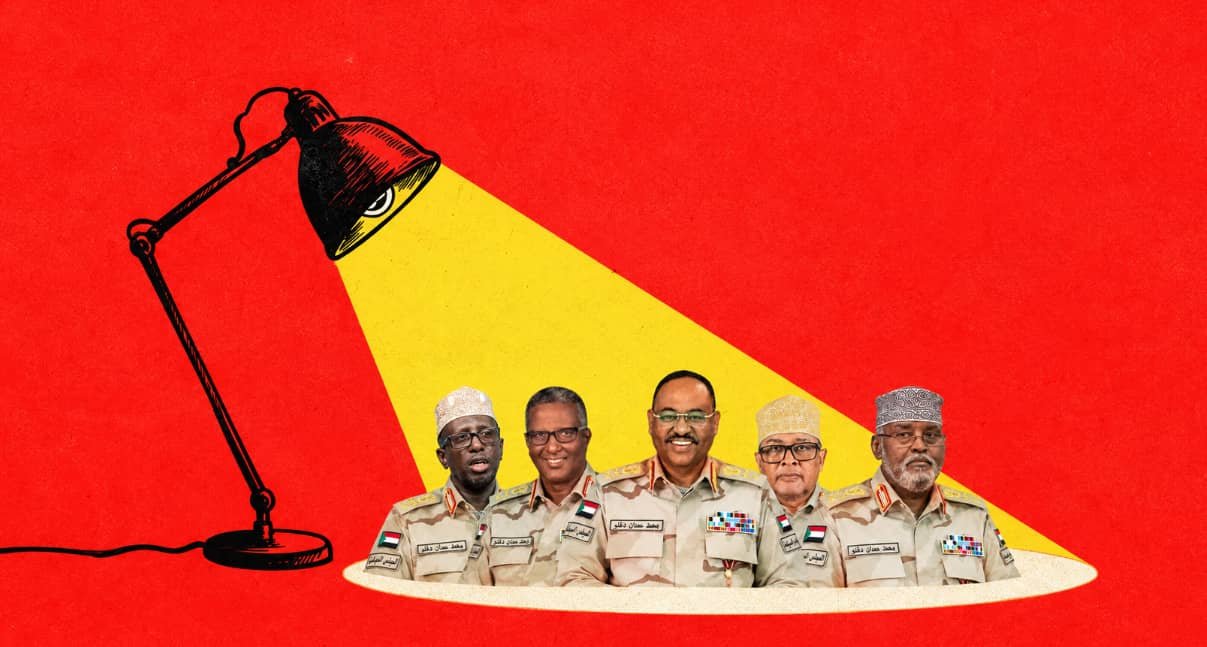
Mohamed Hamdan Dagalo, known across Sudan simply as Hemedti, today commands Africa’s largest irregular army and stands as the leading actor in one of the world’s gravest humanitarian catastrophes. But his story is not that of a rebel. It is the story of a state losing control of a force it built with its own hands.
Hemedti comes from the Mahariya branch of the Rizeigat tribe in Darfur. He has no formal military training; his schooling ended at the primary level, and in his youth he traded camels. His career began with the outbreak of the Darfur rebellion in 2003. Together with his brothers and cousins, he joined the “Border Guards,” a paramilitary force the Bashir regime recruited from Arab tribes, as a private and non-commissioned officer. The force was commanded by Sheikh Musa Hilal, leader of the Mahamid branch; at the time, Hemedti was nothing more than an ordinary NCO under his command.
The world came to know these forces by another name: the Janjaweed. The burning of villages in Darfur, mass rape, and accusations of ethnic cleansing all date from this period. It was here that Hemedti’s true political character took shape: an armed instrument that did the state’s dirty work and was protected and rewarded by the state in return.
At the end of 2006, he fell out with Musa Hilal and, in N’Djamena, in the presence of Chadian President Idriss Déby, tried to align himself with the Justice and Equality Movement. Khartoum’s response was not to punish but to purchase: Hemedti was brought back into the fold with limited assignments in South Darfur and a government advisory post. This was the first link in a pattern that would repeat throughout his life. In every negotiation, Hemedti put his armed strength on the table, and every time he walked away with more.
When the Border Guards were disbanded in 2009, he fell from favour. According to the article, he spent those years guarding former intelligence chief Salah Gosh’s cattle exports to Egypt. Three years of silence followed; but it did not take long for the regime to need him again.
When the rebellion spread toward Kordofan in 2013, Bashir decided to build a new tribal militia. Musa Hilal refused in anger; on the recommendation of Bashir’s military adviser Awad Ibn Auf, the Dagalo brothers were chosen. Thus the Rapid Support Forces were born: Hemedti was tasked with raising 5,000 men, given 60 combat vehicles, and promoted overnight to brigadier general. Because the army refused to absorb the force into its own ranks, the RSF was attached to the Security and Intelligence Service. The seed of today’s war lies precisely in that institutional rejection: the army never regarded the RSF as its own.
In the years that followed, Hemedti achieved what the army could not: he became indispensable to Bashir. His seizure of the Jebel Amer gold mines in Darfur gave him an independent income; the Al-Junaid company grew into an economic empire spanning gold, mining, construction, and trade. Sending troops to Yemen on behalf of the Saudi-Emirati coalition won him direct allies and hard currency in the Gulf. The RSF Act, passed by parliament in 2017, turned the militia into a separate institution within the state.
Here the article’s most striking claim comes into play: Islamist cadres were present at every stage of this growth. From the general manager of Al-Junaid to the intelligence officers who organized the RSF’s structure, from the Hemedti family’s membership in the National Congress Party to his uncle Juma Dagalo’s seat in parliament, the RSF grew from within the Bashir regime and with the regime’s own personnel. The rejection of Hemedti’s request to join the party’s senior leadership, in turn, shows that the Islamists used him but never saw him as an equal.
When the streets toppled Bashir in April 2019, Hemedti was among the generals who overthrew the man who had created him. He rose to deputy chairman of the Sovereignty Council. The attack on the Khartoum sit-in in June of that year, in which more than a hundred civilians were killed, showed early on what his promises of civilian rule were worth.
In this period Hemedti rebranded himself: the representative of Darfur’s marginalized tribes, a revolutionary fighting the “remnants of the old regime.” The numbers, however, tell a different story. The RSF grew from 20,000 under Bashir to 40,000 by December 2019, and surpassed 200,000 before the war. This expansion came from hundreds of officers purged from the army and intelligence services, former governors, former ministers, and tribal leaders from Darfur and Kordofan flowing into the RSF. In other words, while Hemedti was fighting the “remnants,” a significant portion of those remnants were sitting in his headquarters.
The immediate cause of the war was the dispute over integrating the RSF into the army. But the underlying issue was that two parallel states could not coexist in the same country. Hemedti was an actor with his own army, his own economy, and his own foreign policy; Burhan and the army were an institution that could not tolerate this forever. The force Burhan trusted most had become the force that threatened him most.
To read Mohamed Hamdan Dagalo as an ideologue is the greatest analytical error one can make about him. Hemedti’s political biography has been guided by no consistent idea; what guides him is an unshakable belief that armed force is, under all circumstances, the most valuable asset at the bargaining table. He grew up under the patronage of an Islamist regime, took part in the junta that overthrew that regime, spoke as a supporter of civilian transition, and massacred civilians in Khartoum in June 2019. These contradictions are not a flaw of character but a method: every patron is a stepping stone to the next.
Yet leverage strategies have a structural weakness. An actor used as leverage, if he stays in the game long enough, becomes the leverage of others. The war that began in April 2023 is the threshold of that transformation for Hemedti. The Gulf relationship he built by fighting in Yemen on behalf of the Saudi-Emirati coalition has evolved, under wartime conditions, from a partnership into a dependency. The United Nations panel of experts has documented Emirati-origin arms shipments reaching the Rapid Support Forces via Chad and a financing arrangement operating in exchange for gold. Abu Dhabi rejects these findings; Khartoum took the matter to the International Court of Justice in 2024.
The strategic interpretation of this picture is clear to those who see the war in Sudan as part of a regional design. The United Arab Emirates’ expansion policy in the Horn of Africa prefers to work not with strong central states but with controllable local actors; the port of Berbera in Somaliland and the partnership with Ethiopia are examples of this model. In Sudan, Hemedti is the instrument of access to the Red Sea coast, the gold mines, and the agricultural land, and in this reading a weakened central state is not a cost on the road to the objective but the objective itself.
The same framework encompasses Hemedti’s Israel connection. During Sudan’s accession to the Abraham Accords in 2020, Hemedti was one of the principal Sudanese actors in direct contact with Israeli officials and developing relations through intelligence channels. Those who interpret this relationship as part of a strategy to partition Sudan argue that Israel would prefer a Sudan fragmented among tribal militias and open to outside intervention over a re-empowered Islamist state on the western shore of the Red Sea. The parallel government the RSF declared in Nyala in 2025 is, for proponents of this interpretation, no coincidence but the first institutional step toward a political entity centred on Darfur and Kordofan, open to Gulf capital, and severed from Khartoum.
There is a serious objection to this reading. The thesis that attributes Sudan’s fragmentation to external design does not take the country’s own history seriously enough. Darfur’s decades of marginalization, the army’s successive coups, and the centre’s habit of treating the periphery as a zone of extraction made Hemedti possible long before any foreign actor did. In this view, Abu Dhabi and Tel Aviv are fanning the flames; but they are not the ones who lit the fire.
The difference between the two readings does not change the conclusion. The Rapid Support Forces are the joint product of Gulf capital, the gold economy, regional competition over the Red Sea, and the institutional decay of the Sudanese state. Hemedti is the largest and final product of an order in which the state ran its monopoly on violence as a rentable asset; today he is the intermediary who rents that order out to foreign powers. Unless the logic that created him is dismantled, Hemedti’s military defeat will not solve Sudan’s problem. It will merely prepare the ground for the next Hemedti.