Politics & Security
Somaliland's Manufactured Image Collapses in Washington
UN umbrella is closing and prophecies of collapse are back in circulation. But Somalia is no longer the Somalia of 2007
Washington’s decision to pull the plug on the UN Support Office in Somalia (UNSOS), which provides logistics to the African Union mission, triggered a familiar reflex: Mogadishu will fall, al-Shabaab will win, and Somalia will return to the textbooks as a “failed state.” The United States’ agreement in September to a twelve-month extension did little more than postpone that anxiety. The multilateral security umbrella that has stood over the country for twenty years is indeed reaching the end of its life.
But an umbrella closing is not the same as a house collapsing. Even the International Crisis Group’s assessment this month states plainly that predictions that the end of UN and African Union support will bring the government’s collapse and al-Shabaab’s victory are off the mark. That finding is part of a larger story than most observers are ready to accept: Somalia has become far safer than the image it holds in the outside world’s mind, its state far more resilient, and its army far more capable. There is no government today that al-Shabaab is able to topple.
OLD MAP, NEW COUNTRY
When African Union troops landed in Mogadishu in 2007, the transitional government barely controlled a few neighborhoods of the capital. Al-Shabaab was driven out of the capital in 2011 and, over the course of the 2010s, lost most of the urban centers of southern and central Somalia. Today the picture is clear: the government holds the great majority of the cities, while al-Shabaab is largely confined to the countryside. Security in Mogadishu has improved markedly in recent years. With its construction cranes, new hotels, entrepreneurs returning from the diaspora, and full flights, the capital looks less like a city at war than a fast-growing East African port.
This transformation has an institutional counterpart. In 2023 Somalia completed the debt-relief process, was freed from a three-decade UN arms embargo, and joined the East African Community; it has since taken a nonpermanent seat on the UN Security Council. The government is increasing its domestic revenue and financing part of its own military operations from its own budget. The “failed state” label has become the caption to a photograph taken a decade ago.
NOT KABUL
Behind every collapse scenario stands the same analogy: Afghanistan in 2021. The analogy fails for three reasons.
First, no one is leaving Somalia; only the flag is changing. Through the bilateral security agreements it has signed with Uganda, Kenya, and Ethiopia, Mogadishu has ensured that these countries’ troops will stay even if the African Union mission ends. Uganda keeps roughly 2,000 troops around the capital, while Kenya and Ethiopia maintain larger contingents in areas close to their own borders. Even as the mission has shrunk, the number of foreign troops in the country has held steady. These countries are not doing charity work in Somalia; they are defending their own border security. An ally with an interest is more enduring than a donor with a conscience.
Second, the sky belongs to the government. Turkish drones and American counterterrorism operations make it effectively impossible for al-Shabaab to mass in large formations and march on a city. Washington is leaving the multilateral mechanism, not Somalia. It has said explicitly that it will continue its bilateral operations.
Third, al-Shabaab is not an alternative government. It is an insurgent movement that collects extortion money, cuts roads, and rules in the countryside. It has neither the legitimacy nor the capacity to govern a society that is built on clan balances, urban, sustained by trade, and connected to the world through its diaspora. There is no reason it should accomplish now, with the state it faces at its strongest, what it has failed to accomplish in twenty years.
ANKARA MODEL
No outside actor has been as decisive in Somalia’s transformation as Turkey. During the 2011 famine, while the rest of the world managed Mogadishu from Nairobi, Ankara opened an embassy, a hospital, and schools in the capital. Today Turkish companies run Mogadishu’s port and airport, and Turkish Airlines connects the capital to the world.
The security dimension is even more striking. TURKSOM, Turkey’s largest overseas military training base, has trained thousands of Somali soldiers since 2017. The Gorgor commando units that have come out of it are regarded as the most disciplined and most trusted elements of the Somali army. According to Crisis Group, Turkey is today Somalia’s most important bilateral partner: beyond training soldiers, it has deployed advanced assets such as drones and F-16s in the country. The defense and economic framework agreement signed in 2024 added maritime security to this partnership, and the hydrocarbons agreement added energy exploration off the Somali coast.
What sets the Ankara model apart is this: multilateral missions managed a situation in Somalia; Turkey built state capacity. Missions hold bases, consume budgets, and leave when their mandates expire. A trained commando brigade, a functioning port, and a treasury that collects revenue remain. That the United States now regards the multilateral structure as an “unnecessary expense” and favors bilateral support is, indirectly, a vindication of the approach Turkey has pursued for fifteen years.
MORE THAN NUMBERS
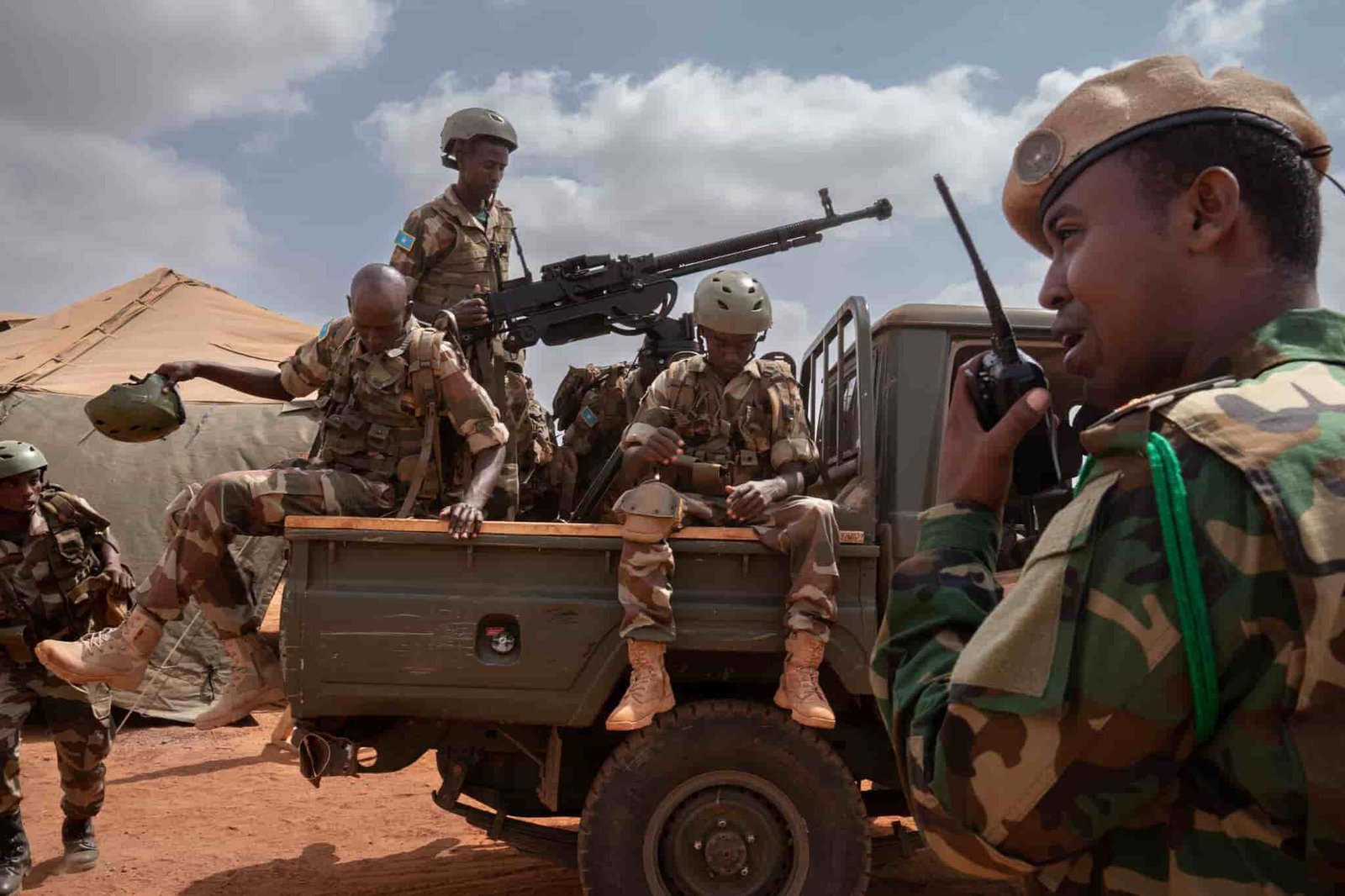
That the Somali National Army has grown stronger in recent years is beyond dispute. More than 10,000 new soldiers have been trained through programs supported by partners such as Turkey, the United Arab Emirates, and Eritrea. Mogadishu announced that, as of August, it had 14,000 soldiers available for operations. In the Lower Shabelle campaigns of 2025–2026, it was the Somali army, not the African Union, that led the offensive.
Of course, this army still needs outside support, and some positions taken over from the African Union have been lost in the past. But what matters here is the direction of travel. A decade ago the Somali army was a loose collection of clan militias. Today it has units that are centrally trained, regularly paid, and operating in coordination with air support. Al-Shabaab’s 2025 offensive captured some rural positions but failed to take a single major city. That means the army was tested and, in the main, held.
A NEW ERA
The closure of UNSOS marks the end of an era, but it was a bad era. For twenty years Somalia’s security was entrusted to an arrangement voted on in New York, financed in Brussels, and deployed from Kampala. That arrangement did its job: it bought the state time to breathe. That time was well used. Today Somalia has a government that holds its cities, units that have proven themselves in the field, neighbors determined to stay for the sake of their own border security, and, in Ankara, a strategic partner that has invested for the long term.
Al-Shabaab will persist in the countryside for some time yet and will, now and then, inflict pain. But it is far from having the strength to march on Mogadishu and topple a government. The question before Somalia is no longer whether it will survive but how quickly it will reach full sovereignty. And the answer to that question lies not in Washington or New York, but in Mogadishu.