Explore
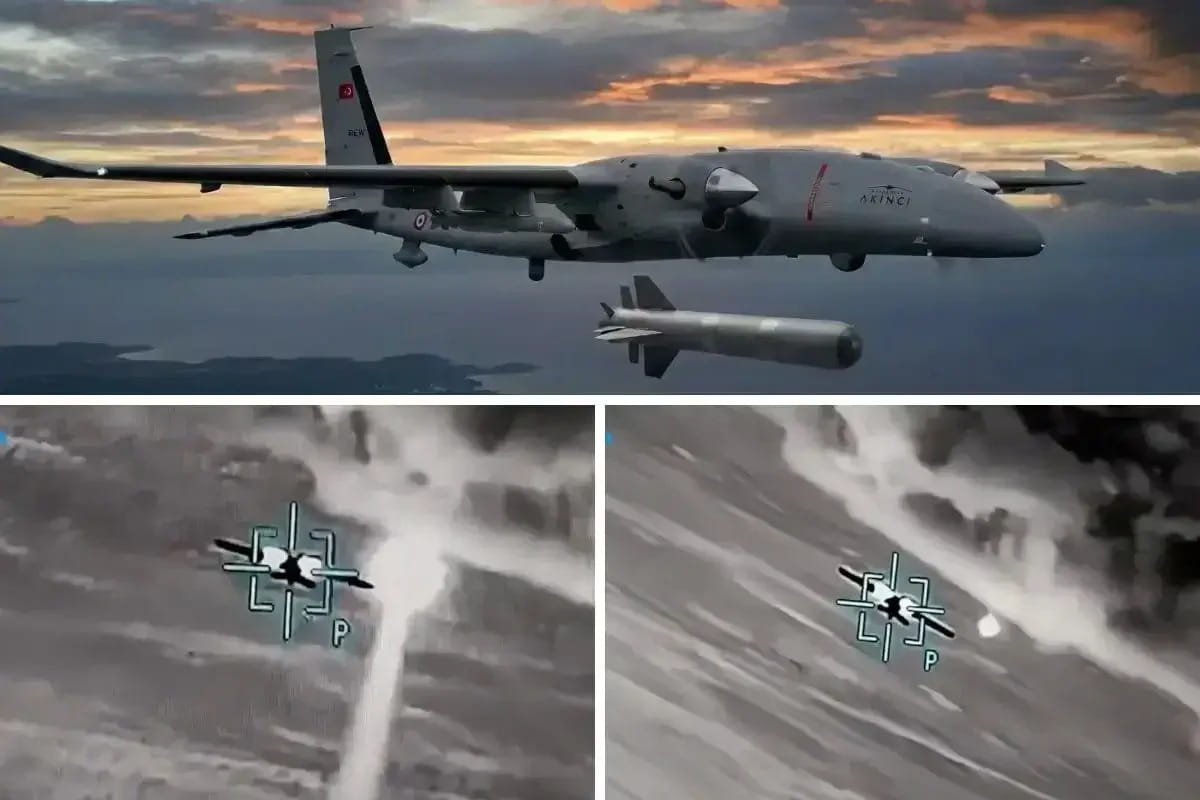
Akıncı Gives Sudan’s Army Total Command of the Skies
Since the outbreak of Sudan's war in April 2023, one question has puzzled observers of the battlefield: how has the Rapid Support Forces, a paramilitary group fighting a regular army, repeatedly fielded capabilities that the Sudanese Armed Forces themselves lack? The RSF was among the first parties to the conflict to deploy drones at scale, and it has surprised the army again and again with new categories of weaponry. The answer does not lie in Sudan. It lies in the United Arab Emirates and, increasingly, in Chad.
An adaptive pipeline
What distinguishes the Emirati role in this war is not simply the volume of support but its adaptability. Each time a route is exposed, the method changes. A telling episode came in 2025, when the Sudanese army intercepted a shipment of strategic munitions that, according to military sources, was intended for an assault on Port Sudan, the government's wartime seat. The seizure was a rare intelligence success, but its more lasting effect was to force a change in Abu Dhabi's approach.
Since then, the pattern that emerges from tracking supply routes is one of indirection. Financing and matériel destined for the RSF pass through Chad via third parties, with N'Djamena serving as a transit node rather than an origin. Weapons are purchased from a given supplier and received by the UAE, then shipped onward to Chad under the cover of humanitarian assistance before being handed to the RSF. This appears to have been the route for the Chinese-made FK-2000 air defense system and AH4 howitzers now in RSF hands. Once such deliveries are complete, Chadian authorities have on occasion announced that weapons belonging to their own forces had gone "missing" on Chadian soil, a convenient explanation for hardware that later appears in Darfur.
Why route shipments through an intermediary rather than deliver them directly? An intermediary state offers logistical protection, plausible deniability, and the practical facilities of an established land border. It also spreads responsibility: when arms cross from Chad rather than arrive from the Gulf, the question of who violated the Darfur arms embargo becomes harder to answer.
Strategic drones follow a different logic. Electronic components are sourced from India, Algeria, and elsewhere, then assembled into complete aircraft in facilities inside the UAE. A third possibility should not be dismissed: that final assembly takes place outside the Emirates altogether, in Libya or in Chad, closer to the front and further from scrutiny.
A long history of enmity
None of this can be understood apart from the fraught history between Khartoum and N'Djamena. Chadian support for armed movements in Sudan is not new. In the 2000s, each government accused the other of sponsoring cross-border insurgents, and relations ruptured entirely after the Darfuri rebel leader Khalil Ibrahim was received in N'Djamena. Libyan mediation eventually produced a normalization: in 2010 the two countries created a joint border force, and in February of that year, then-President Omar al-Bashir announced in Khartoum that relations had been restored.
The détente did not hold. Tensions returned, along with tit-for-tat attacks. In December 2024, the presidential palace in N'Djamena came under assault. Later, explosions were reported near Wadi Seidna, the air base north of Omdurman, and Sudan's defense minister stated publicly that the attack had been carried out by drones launched from Chadian territory. What was notable about those aircraft was their provenance: they were advanced systems purchased from Turkey and modified to appear as Chadian assets. When communications with El Fasher were cut and the city subsequently fell, Ankara froze the drone contracts it had signed with N'Djamena, an implicit acknowledgment of how its exports were being used.
A new escalation
In recent days, Chinese-made CH-4 drones have been observed in Chad. This is a development that merits close attention. The CH-4 is a medium-altitude, long-endurance platform capable of both surveillance and strike missions, and there is a real prospect of its use in the Sudanese army's area of operations, particularly along the Sudan-Chad frontier. If so, it would mark a qualitative shift from supplying the RSF to projecting force from Chadian soil.
Chad is thus gradually turning into a military theater in its own right. So long as supply and operational activity continue through Iriba, other Chadian staging points, and Ethiopia, the possibility that fighting spills deeper into Chadian territory cannot be excluded. The Sudanese army's recent strikes inside Chad, which Khartoum describes as targeting RSF convoys, should be read in that light, as a signal that the supply line itself is now considered a legitimate target.
Yet there are limits. The Sudanese government has no interest in drawing its own external partners into a direct confrontation with Chad and Chad's regional allies. Khartoum wants the pipeline cut, not a second war. That restraint is real, but it depends on the pipeline not becoming permanent. The international community's response, which has so far focused on condemning Sudanese strikes while remaining largely silent on what those strikes were aimed at, does little to encourage it.
The war continues, and its center of gravity is shifting westward. Whether Chad remains a conduit or becomes a battlefield will depend less on decisions made in Khartoum than on those made in N'Djamena and Abu Dhabi.